
There’s a very specific kind of comfort show that doesn’t really announce itself as important, but somehow ends up taking over your entire evening. You watch one episode, just to see what it’s like, and suddenly you are several episodes deep, emotionally invested, and treating fictional lives like they belong in your group chat. It is easy to start, hard to stop, and strangely comforting in a way that feels familiar even on the first watch. That is where the Mindy Kaling Effect begins.
What makes these stories work so effortlessly is that they feel emotionally recognisable. They are not built around extraordinary situations, but around the kind of everyday chaos that actually shapes how life feels: friendships that live through constant messaging, conversations that get overanalysed after they end, and small moments that somehow end up carrying more emotional weight than expected. It mirrors how experiences actually unfold when you are inside them, not when you are trying to explain them later.
That sense of recognition sits at the centre of everything connected to Mindy Kaling. Her storytelling does not observe life from a distance. It stays inside it. The humour, the awkwardness, the emotional overthinking, and the honesty all feel drawn from lived experience rather than constructed drama. It feels like real emotional patterns translated into television, with just enough sharpness to make them land differently.
Across her work, she has described her shows as reflecting different chapters of her life, each one capturing a distinct stage of becoming. Not as a strict autobiography, but as emotional memory shaped into story.

In Never Have I Ever, it’s that teenage chapter where everything feels huge. Friendships feel absolute, embarrassment feels permanent, and every emotion hits like it has nowhere else to go. It’s intense, messy, and completely unfiltered in a way that feels very true to that age.
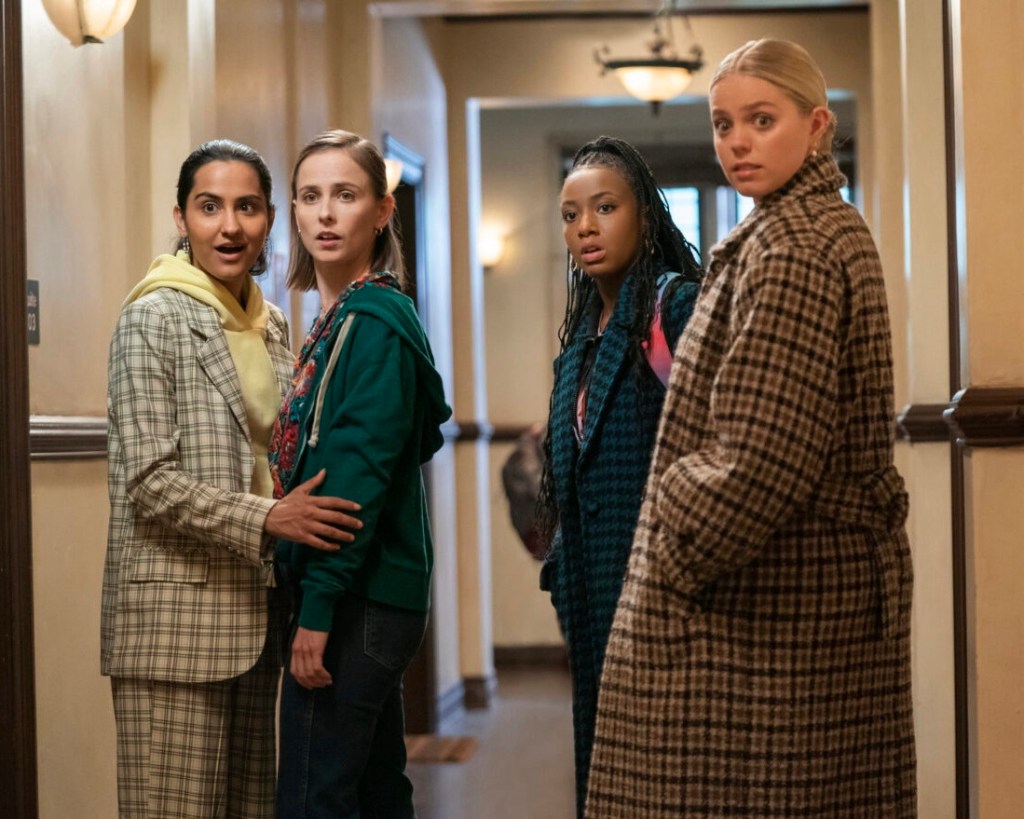
In The Sex Lives of College Girls, it’s early independence without any real instruction manual. Everything is in motion: identity, friendships, confidence. Some days you feel like you’ve got it, other days you very much do not. It’s chaotic, funny, and a bit emotionally unsteady in the most relatable way.

In Not Suitable For Work, it’s the early career phase where everything feels slightly improvised. You’re trying to build a life while still figuring out what version of yourself is even showing up to it. It’s ambitious, uncertain, and very present-tense in the way adulthood actually feels.
What connects all of it is tone. The humour never sits above the characters, it sits inside them. People overthink, misread, recover, spiral slightly, then immediately debrief with friends as if that’s just part of staying alive. Nothing feels over-designed. It feels lived in.

Then there is Running Point. One of the best shows to ever exist on streaming. It screams female empowerment, it’s funny and full of great storylines. I have to admit, I have seen the show about five times already and I will watch it again.
All this greatness comes through Kaling International, a space known for centering women’s inner lives with specificity rather than simplification. The focus is always on behaviour that feels real: how people talk when they’re unsure, how friendships stretch and snap and return in different forms, how feelings rarely arrive in the right order.
By the end, what stays with you is not plot, but recognition. A sense of seeing emotional patterns that feel familiar even when the stories are fictional. That is the essence of the Mindy Kaling Effect. Not perfection, not distance, but familiarity that quietly sticks.
And that is why these shows linger. Not because they demand attention, but because they feel like they understand how life actually moves, and how people move through it together while it does.
 ROARA Magazine